

Made In Great Britain

Direct from our factory

Product Test Results

All test results published

Expert Technical Advice

Call or chat with our team

Click an icon to explore features Tap an icon to explore features
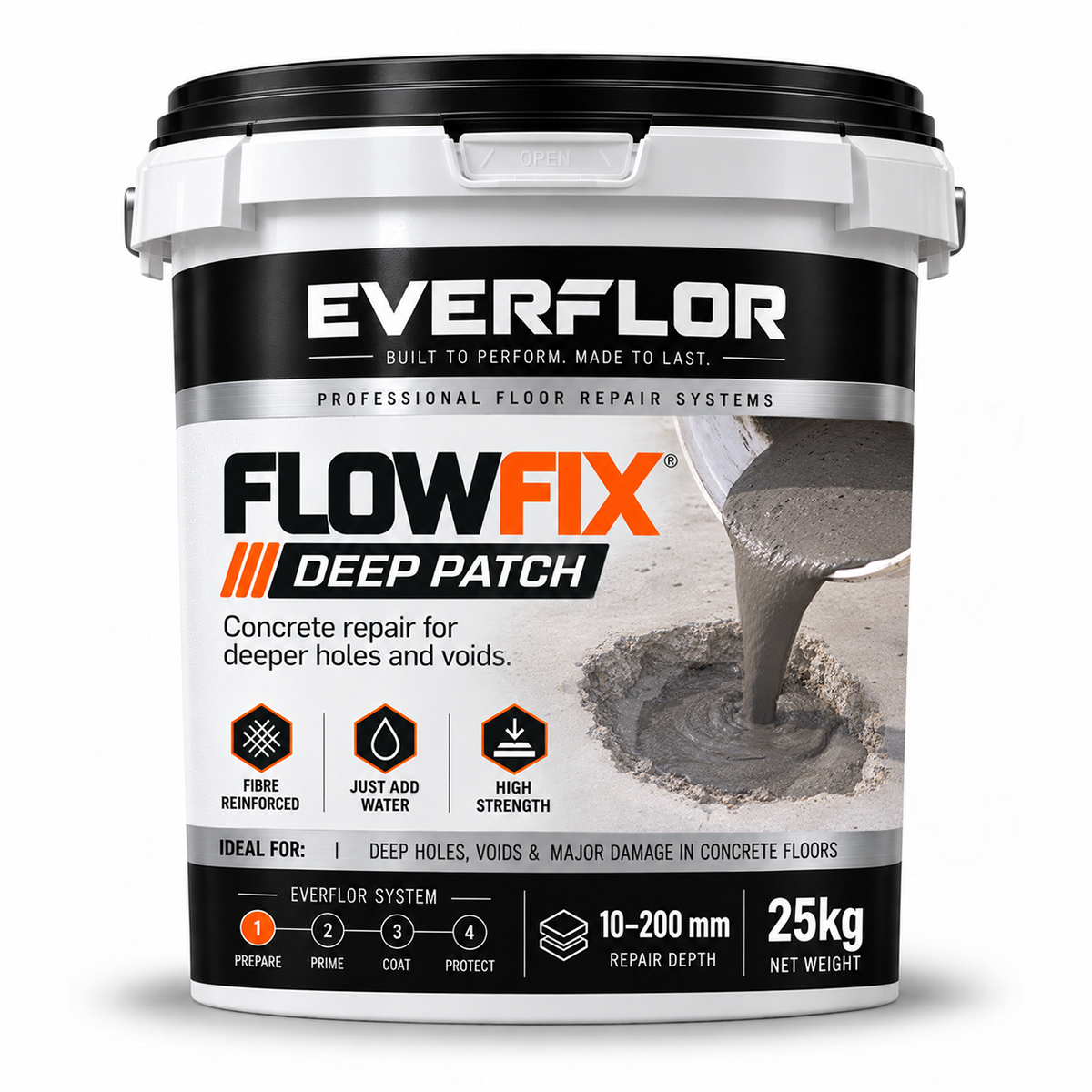
EverFlor - FlowFix Deep Patch - Deep Concrete Repair Mortar

Deep Section Single Pour

Add 25kg of powder to 5 litres of clean water and mix to a smooth, lump-free consistency. The flowable mortar runs to the base and corners of the void and fills it as one section, at any depth from 100mm to 200mm. Pot life is 5-10 minutes at 20°C, so mix only what you can pour straight away.

Same Shift Return

The reinforced cement and polymer powder sets fast, so the floor goes back into use within the working day. At 20°C the repair takes foot traffic after 30 minutes and forklift traffic after 2 hours, with full cure at 24 hours. Cold conditions and deeper sections lengthen these times.

Primer Free Placement

The mortar is poured directly into the prepared void, with no separate primer coat or bonding layer before it. Cut the repair back to sound, clean concrete and remove all loose material first. Do not feather the mortar out to a thin edge; the minimum repair depth is 100mm.

Cured Service Range

Once cured, the repair reaches a compressive strength of 45N/mm² after 28 days and operates between -20°C and 70°C on internal and external floors. Apply and store between 5°C and 30°C. VOC content is below 30 g/l, and tools clean in warm soapy water.

Performance Profile

Single-Component Cement and Polymer Repair Mortar. A reinforced powder that you mix with clean water and pour into deep voids. It reaches 45N/mm² compressive strength after 28 days and takes forklift traffic two hours after placing at 20°C. It needs no primer and cures fully in 24 hours.

Download Data Sheet
Repair Depth 100-200mmrepair depth per application
Coverage 0.25m²per 25kg at 50mm
Pot Life 5-10 minsat 20°C
Finish Flowablegrey cement mortar

Essential Information

Product Details

Description

FlowFix Deep Patch is a deep concrete repair mortar for holes and voids in damaged concrete floors. It is a reinforced cement and polymer powder. Add clean water, mix and pour. The mix flows to the bottom of the void and fills it as a single section.

It is the deep-section repair in the EverFlor FlowFix range, made for repairs 100mm to 200mm deep. For shallower patch repairs, use FlowFix Patch. Where a floor needs its holes and voids filled before resurfacing, fill them with Deep Patch first and then resurface.

It is a single-component product. There is no resin or hardener to proportion, only water. No primer is required. It works inside and outside and returns the floor to forklift traffic after two hours at 20°C.

Recommended areas of use

  • Damaged concrete floors
  • Warehouse and factory floors
  • Loading bays
  • Distribution centres
  • Workshops
  • Industrial premises
  • Internal and external concrete surfaces
  • Holes and voids prior to resurfacing

Features

  • Flowable consistency, so the mortar runs into the base and corners of a deep void without heavy compaction.
  • Places 100mm to 200mm deep, so a deep hole fills in one application rather than in built-up layers.
  • Mixes with water only: 5 litres per 25kg bag, with no second component to measure.
  • No primer required, which removes a step and a product from the repair.
  • Takes foot traffic after 30 minutes and forklift traffic after 2 hours at 20°C, so working areas reopen the same shift.
  • Reaches a compressive strength of 45N/mm² after 28 days.
  • Rated for an operating temperature of -20°C to 70°C once cured, for both internal and external floors.
  • VOC content below 30 g/l; tools clean in warm soapy water.

Good to know

  • Pot life is 5-10 minutes at 20°C. Mix only as much as you can pour in that time.
  • Apply between 5°C and 30°C. Cure and return-to-service times lengthen in cold conditions and with deeper sections.
  • The minimum repair depth is 100mm. Do not feather the mortar out to a thin edge; cut the repair to sound, square edges.
  • Do not add more water than the stated ratio. Excess water weakens the cured mortar.
  • Supplied in grey, in 25kg bags. Store between 5°C and 30°C. Shelf life is 12 months.
Application

SURFACE PREPARATION

Make sure the surrounding concrete is structurally sound. Break out all loose and friable material. Cut the repair to firm, square edges. Do not leave thin feathered edges.

The repair must be 100mm to 200mm deep. Remove all dust, oil, grease, paint and other contamination from the base and sides of the void. No primer is required.

MIXING

Use 5 litres of clean water per 25kg bag. Pour the water into the mixing vessel first. Add the powder gradually while mixing continuously. Mix to a smooth, lump-free, pourable consistency.

Do not add more water than this ratio. Excess water reduces the strength of the cured mortar. Pot life is 5-10 minutes at 20°C, so mix only what you can pour in that time.

APPLICATION

Apply between 5°C and 30°C. Pour the mixed mortar into the prepared repair immediately. Let it flow into the full depth and edges of the void. Use a steel float or trowel to assist placement and to finish flush with the surrounding floor.

Clean tools in warm soapy water straight after use.

CURING AND RETURN TO SERVICE

At 20°C the repair takes foot traffic after 30 minutes and forklift traffic after 2 hours. Full cure takes 24 hours. Lower temperatures, deeper sections and site conditions extend these times, so check the repair before reopening the area.

Technical Data
Finish Flowable mortar
Coverage Approximately 0.25m² at 50mm thick per 25kg
Full cure 24 Hours
Suitable substrates Damaged concrete floors • Warehouse and factory floors • Loading bays • Distribution centres • Workshops • Industrial premises • Internal and external concrete surfaces • Holes and voids prior to resurfacing
Shelf life 12 months
VOC content < 30 g/l
Mixing ratio 25kg of FlowFix to 5l Water
Cleaning tools Warm soapy water
Number of components 1 (mix with water)
Foot traffic 30 Minutes at 20°C
Composition Reinforced cement & polymer powder
Primer required No primer required
Depth 100mm - 200mm
Forklift Ready 2 Hours at 20°C
Operating Temperature -20°C - 70°C
Compressive Strength 45N/mm² after 28 days

The Knowledge Hub

Everything You Need to Know

Browse our collection of in-depth articles and how-to guides designed to help you get the most out of this product. whether you need help with surface preparation or application advice, we have you covered.

View Technical Hub

A visual comparison of a mossy, weed-infested block paving driveway next to a freshly cleaned section in the UK.
  • by Sam Marriott

Restoring Block Paving: Removing Moss, Weeds, and Lichen

Block paving is the most popular driveway choice in the UK, but it has a major design flaw: Joints. Those thousands of gaps between the bricks are the perfect nursery for weeds, moss, and the dreaded "black spot" lichen. Every...

Read more

An unbranded industrial floor scrubber being used to maintain the high-gloss shine on a polished concrete warehouse floor.
  • by Sam Marriott

Deep Cleaning Polished Concrete Without Damaging the Shine

Polished concrete is often sold as the "maintenance-free" flooring option. That is a lie. Yes, it is incredibly durable. It won't peel or flake like paint. But if you ignore it, or worse - if you clean it with the...

Read more

Two unbranded silver tins labeled Acid and Alkaline on an industrial concrete warehouse floor.
  • by Sam Marriott

Acid vs. Alkaline Concrete Cleaners: Which is Best for Your Floor?

If you walk into a hardware store and ask for "concrete cleaner," you'll probably end up with a few different options in-front of you. Most people grab the bottle with the most aggressive warning label, thinking "stronger is better." But...

Read more

How to Sand a Painted Concrete Floor for Recoating
  • by Sam Marriott

How to Sand a Painted Concrete Floor for Recoating

In our Sanding vs. Grinding: Preparing Previously Painted Concrete guide, we established that if your floor passes the Cross-Hatch Adhesion Test, then the next step for recoating will be sanding. Choosing to sand rather than grind saves you hundreds of pounds in equipment rental and diamond consumables....

Read more