System Overview
For interior concrete floors that are worn, rough or pitted throughout, re-surfacing lays a new wearing surface over the existing slab. It is the repair for a floor whose surface has failed while the slab beneath remains sound. Patching is no longer practical at that stage, and a floor paint would only follow the damage.
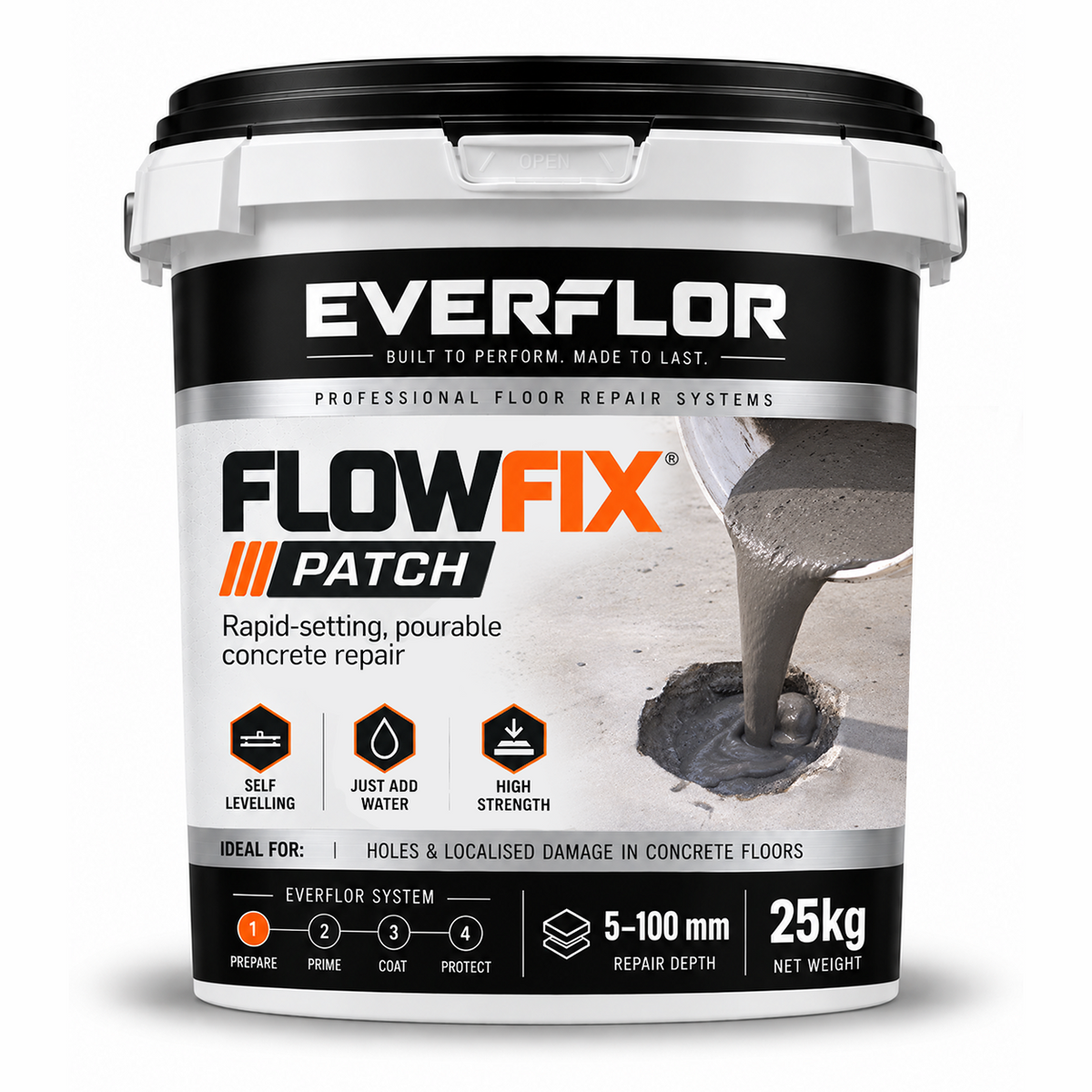
EVEREST Everflor FlowFix Resurface is the resurfacer in this range. It is a four-component, resin-modified cementitious system. A fibre-reinforced cement powder is mixed with a liquid resin at the point of use. The mix is laid over two supplied primers in a single coat.
The mixed material is poured and spread across the whole floor. It flows out under a float and spiked roller and settles into one smooth, level grey surface. Pits are filled and exposed aggregate is covered.
The new surface can be left as the working floor. It can also serve as a smooth base for a compatible floor coating.
Suitable Substrates & Surface Preparation
Interior concrete is the substrate for FlowFix Resurface. Typical candidates are old slabs with exposed aggregate, surface pitting or a rough texture left by years of wear.
The slab itself must be sound. A resurfacer adds a new surface and does not add structural strength. Hollow, rocking or broken sections need repair or replacement before the floor is resurfaced.
General good practice is to prepare the whole floor mechanically. Grinding or shot blasting removes laitance, old coatings, oil and weak concrete, and leaves a clean, open surface. Vacuum the floor thoroughly afterwards.
Deal with isolated defects first. Deep holes are filled with a hole repair mortar, and cracks are treated on their own terms. Existing movement joints should be carried through the new surface, not buried.
The system includes two primers, applied before the resurfacer. Follow the product data sheet for the order, coverage and timing of each stage.
Performance Characteristics & Limitations
FlowFix Resurface produces a level new wearing surface on interior concrete. It is a cement-based material with fibre reinforcement and resin modification, laid in a single coat.
The main benefit is a change in the surface itself. A floor paint follows every pit and stone in a worn slab. A resurfacer fills them, so the finished floor is smooth and continuous.
A smooth surface has practical consequences. It is simpler to sweep and clean than pitted concrete, and wheeled equipment runs across it with less vibration. It also gives a floor coating an even base on which to form a film.
The limits are equally clear. FlowFix Resurface is for interior concrete, so it is not the product for external yards or tarmac. It is designed to be spread across a whole floor. For a few isolated holes, a hole repair mortar is the more direct repair.
Thickness, cure times and traffic times are set out in the product data sheet. Confirm them there before planning a shutdown, and allow longer in cold conditions.
Internal vs External Considerations
FlowFix Resurface is specified for interior concrete floors. Worn interior slabs are common in older warehouses, factory units and workshops.
Indoors, the main planning issues are access and time. The floor must be cleared, prepared, primed and laid in sequence, and the area stays closed until the surface has cured. Working bay by bay, with joints as break lines, keeps part of a building in operation.
Conditions inside the building still matter. Cold slabs slow curing, and draughts or direct heat can dry a cementitious surface unevenly. Keep conditions steady during laying and early cure.
For external concrete, use a product stated for exterior use. For worn tarmac and asphalt, see the Asphalt Re-Surfacing & Screeding range.
Selection Guidance & When to Specify Alternatives
Specify re-surfacing when the damage is general. Signs include exposed aggregate, pitting along traffic routes and a surface too rough to paint or clean.
Specify a hole repair mortar when the damage is local. A few defined holes in an otherwise good floor do not justify a new surface.
Decide early whether the resurfaced floor will be left as it is or coated. FlowFix Resurface can be left as the working floor. Where colour or line markings are needed, apply a compatible floor coating over it.
A resurfacer is not a traditional sand and cement screed. A floor that needs substantial thickness, new falls or a change in level calls for a screed or a new slab.
Where the slab is cracked through, damp from below or moving, resolve that first. A new surface laid over an active defect will show the same defect.