

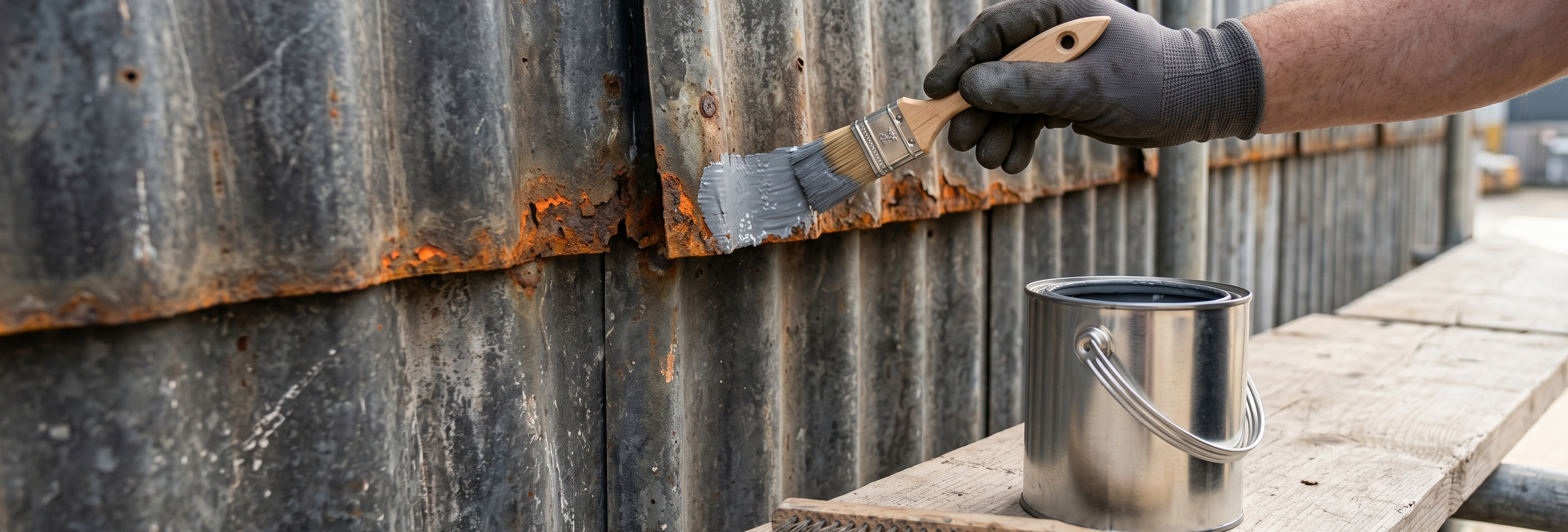
If you own or manage a commercial unit with a metal profile roof, you are likely sitting on a ticking time bomb. Walk around your building. Look at the vertical seams where the metal cladding sheets overlap, or check the gutter line. Do you see the PVC coating curling up? Do you see blistering red rust creeping up from the bottom edge of the sheet?
This is Cut-Edge Corrosion. It is the number one cause of leaks in commercial properties, and it is the first thing a surveyor looks for during a dilapidations inspection. If you catch it early, it is a simple repair. If you ignore it, the rust will eat through the lap, capillary action will suck water into the building, and you will be facing a re-roofing bill in the tens of thousands.
Here is the industry-standard protocol for stopping the rot.
Why It Happens
Why does the edge fail when the rest of the roof is fine? Most industrial units use Plastisol-coated steel. In the factory, the steel is galvanised and coated before it is cut to size. When the guillotine cuts the sheet, it exposes a tiny strip of bare steel on the edge.
-
The Wick Effect: When sheets overlap, they trap water. This exposed edge sits in dampness.
-
The Creep: The steel rusts. The rust expands. It pushes the plastic coating (Plastisol) up and away from the metal.
-
The Result: The coating peels back like a banana skin, allowing water to travel further up the sheet.
The "V-Cut" or Feather Edge
You cannot just paint over the peeling plastic. The rust is active underneath the loose coating. The repair fails or succeeds at this stage.
Step 1: You must remove the loose coating.
-
Use a sharp knife or scraper to cut the peeling Plastisol back until you reach a point where it is still firmly stuck to the steel.
-
Crucial: You must expose the solid metal. If you leave a pocket of air under the coating, the corrosion will continue.
Step 2: Mechanical Abrasion
-
Use an angle grinder with a wire brush or a heavy-grit sanding disc.
-
Remove the loose red rust scale from the exposed steel. You want to see bright, clean metal (St3 Standard).
-
Feather the edge of the remaining plastic coating so there is a smooth transition, not a hard step.
The Treatment: Three-Part System
The industry relies on specialist silicone or PU systems. Standard metal paint is not enough here. You need a system that can bridge the gap between the sheets and flex with the roof movement.
Part A: Passivation
-
Apply an anti-corrosive primer to the bare metal you just exposed.
-
This chemically stops the rusting process (passivates the steel).
→ Everest - Anti-Corrosive Oxide Primer
Part B: The Seal
-
This is the most important step.
-
Apply a thick bead of Gun Grade Silicone or mastic into the overlap gap between the two sheets.
-
Why? This stops capillary action. It prevents water from being sucked back up between the sheets.
Part C: The Top Coat
-
Apply the specialist topcoat over the primer, the mastic, and the surrounding original coating.
-
This creates a seamless, rubberised bandage over the entire vulnerable edge.
-
It is usually colour-matched (e.g., Goosewing Grey) to blend in with the roof.
→ Everest - Agricultural & Industrial Barn Paint
The "UV" Factor
Why use expensive Silicone systems instead of cheap Bitumen? UV Stability. Roofs get hot. Bitumen dries out and cracks in the sun. Cut-edge systems are designed to withstand extreme UV exposure and thermal expansion (the roof sheets expanding in summer and shrinking in winter). They remain elastic for 10-15 years. If you use a rigid repair product, it will snap in the first frost.
Inspection Cycles
Cut-edge corrosion doesn't happen overnight. It creeps roughly 1mm to 2mm per year initially, then accelerates once the coating lifts.
-
Year 1–10: Usually fine.
-
Year 15: The "Danger Zone." This is when the factory cut edge usually breaks down.
-
The Fix: Schedule a drone survey or a manual inspection every 2 years. Catching it when the peel is only 10mm deep is a cheap maintenance job. catching it when the sheet is perforated means replacing the panel.
Conclusion
Cut-edge corrosion is not a cosmetic issue; it is a structural failure of the roof's waterproofing. Treating it is a fraction of the cost of re-sheeting. Don't wait for the leak. Look for the peel.
-
Cut back the loose coating
-
Grind off the rust
-
Seal the gap with Gun Grade
Ready to patch the corrosion?
→ Shop our Everest - Anti-Corrosive Oxide Primer
Share:
Encapsulating Lead Paint: Safe Prep for Old Farm Buildings
Adhesion Testing: Checking if Paint Will Stick to Your Composite