

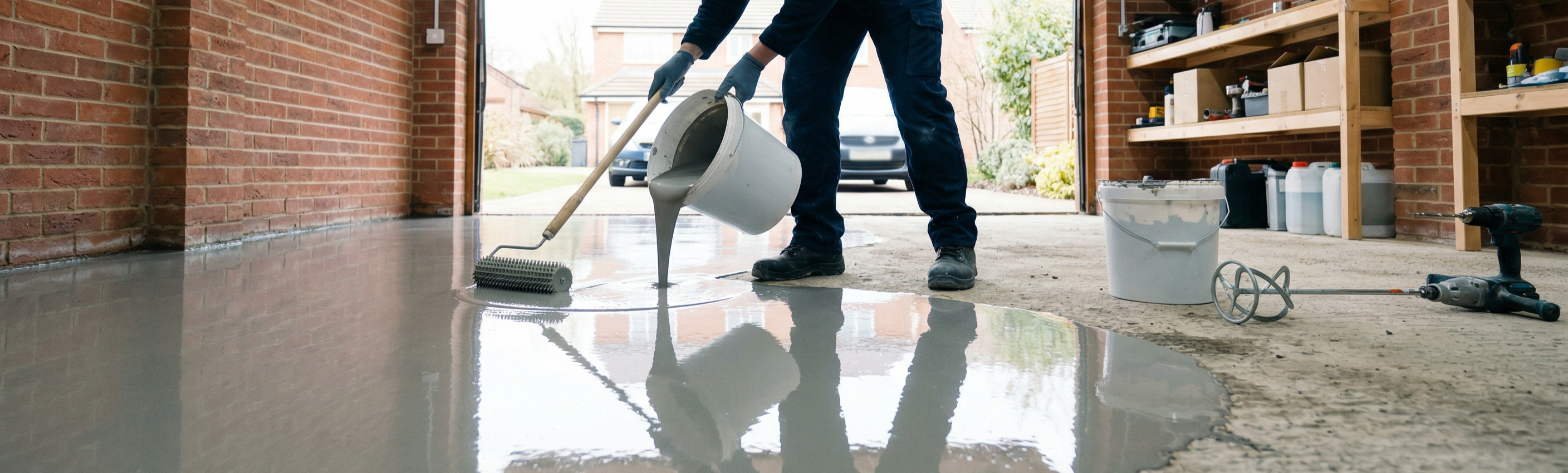
Il existe une règle stricte dans l'industrie des revêtements de sol : La peinture très brillante révèle tout.
Si le sol de votre garage est piqué, ondulé ou rugueux comme un paysage lunaire, l'application d'une peinture époxy brillante ne cachera pas ces imperfections. Au contraire, elle les mettra en évidence. La lumière accrochera chaque ondulation et chaque cratère, vous laissant avec un sol d'apparence bon marché et peu professionnelle.
La peinture recouvre le profil, elle ne le modifie pas.
Si vous souhaitez obtenir une finition « effet verre » digne d'une salle d'exposition sur une dalle ancienne et abîmée, vous ne pouvez pas vous contenter de la peindre. Vous devez d'abord la resurfacer. Vous avez besoin d'un composé autonivelant (SLC).
Qu'est-ce qu'un composé autonivelant ?
Le SLC n'est pas seulement du « béton fluide ». C'est un ciment modifié aux polymères conçu pour couler comme une pâte liquide. Il cherche son propre niveau, remplissant les creux et enfouissant les agrégats rugueux pour créer une surface parfaitement plane et lisse.
Cependant, le nom est trompeur. Il ne fait pas tout le travail pour vous. Si vous le versez simplement et vous en allez, vous vous retrouverez avec un désastre.
Règle n°1 : Vous devez apprêter (non négociable)
La plus grande erreur que commettent les bricoleurs avec les composés de nivellement de sol est de les verser directement sur du béton brut.
Le vieux béton est « assoiffé ». Si vous versez du SLC humide dessus, la dalle aspire instantanément l'eau du mélange. Cela arrête le flux et fait que le niveleur se fige et se fissure avant de s'étaler.
-
La solution : Vous devez d'abord sceller le support avec un apprêt dédié (généralement à base de SBR ou d'acrylique, parfois époxy). Cela empêche l'aspiration et assure que le SLC adhère au sol, et non seulement à la poussière.
Règle n°2 : Ne pas doser l'eau « à l'œil »
Lors du mélange de béton, vous pouvez généralement évaluer la consistance à l'œil. Avec le SLC, vous ne le pouvez pas.
-
Trop peu d'eau : Il ne coulera pas. Il restera en bloc.
-
Trop d'eau : La chimie se brise. Le sable lourd coule au fond, et une couche d'eau faible et laiteuse remonte à la surface. Quand il sèche, la surface sera molle et poussiéreuse, et votre peinture industrielle pour sols se décollera.
Suivez scrupuleusement les instructions du sac. Mesurez l'eau. Ne devinez pas.
Règle n°3 : L'outil indispensable
Vous ne pouvez pas appliquer le SLC avec une truelle seule. Vous avez besoin d'un rouleau débulleur.
Lorsque vous mélangez la poudre, vous incorporez des milliers de minuscules bulles d'air dans le liquide. Si vous les laissez, elles remonteront à la surface au fur et à mesure que le sol durcira, vous laissant avec un sol couvert de petits trous d'épingle.
-
La technique : Une fois que vous avez versé et étalé le composé en place, passez immédiatement le rouleau débulleur. Cela fait éclater les bulles et aide à mélanger les différentes coulées pour une finition sans couture.
Puis-je peindre sur un composé autonivelant ?
Oui, mais il faut être prudent. Les SLC nécessitent généralement des traitements supplémentaires avant d'être prêts à être apprêtés et peints.
-
Attendez : La plupart des composés sont "marchables" en 4 heures, mais retiennent l'humidité pendant des jours. Ne commencez aucun travail de préparation avant que le SLC ne soit complètement durci.
-
Décapez : Nous recommandons toujours de décaper les sols finis avec un composé autonivelant avant de les apprêter ou de les peindre. Cela garantit que le support présente suffisamment de pores pour que l'apprêt et la peinture adhèrent correctement.
-
Apprêtez : Comme la nouvelle surface est poreuse, vous devez appliquer un apprêt polyuréthane ou un apprêt époxy avant votre couche de finition. Si vous sautez cette étape, le SLC aspirera la résine de votre peinture, laissant une finition inégale et terne.
Conclusion
Le resurfaçage d'un sol de garage est le seul moyen de transformer une dalle rugueuse de 50 ans en un sol digne d'une salle d'exposition moderne.
Cela ajoute une journée à votre projet, mais dix ans à l'aspect du sol. Aplatissez d'abord la surface, et la peinture deviendra la partie la plus facile.
Partager:
Mise en œuvre mécanique : Préparation du béton lissé mécaniquement
Ponçage vs. Meulage : Préparation du béton déjà peint